Blessed are they that have not seen, and believe.

thomas_std_tJoh 20:25 The other disciples therefore said unto him, We have seen the Lord. But he said unto them, Except I shall see in his hands the print of the nails, and put my finger into the print of the nails, and thrust my hand into his side, I will not believe.  ¶ And after eight days again his disciples were within, and Thomas with them: then came Jesus, the doors being shut, and stood in the midst, and said, Peace be unto you. Then saith he to Thomas, Reach hither thy finger, and behold my hands; and reach hither thy hand, and thrust it into my side: and be not faithless, but believing.  And Thomas answered and said unto him, My Lord and my God. Jesus saith unto him, Thomas, because thou hast seen me, thou hast believed: blessed

First, I thank the Lord for His patience. Thomas was a little impulsive at times – though very loyal. He was willing on two or three occasions to die with the Lord, if necessary. But in this passage, we see a lapse of faith. And the Lord, instead of rebuking him, understood that this was a time for careful restoration of faith. And thank the Lord that He does that in us as well.

The passage primary application here, however, is when the Lord says “blessed are they that have not see, and yet have believed…” The Lord places high value on faith. We understand that faith is the substance of things hoped for, the evidence of things NOT SEEN. The Lord regards highly and rewards greatly those who follow Him in faith – not having seen – no matter where the road may lead. The challenge this morning is to follow in faith. When we don’t understand the trial (Job), follow in faith. When we can’t see the road ahead (Abraham), follow in faith. When persecution comes (Paul), follow in faith. And when it comes to living for the sake of eternity, even when it means disregarding this world’s pleasure and treasure for a city to come (Moses), let us follow in faith. For, blessed are they (we) that have not seen, and yet have believed.
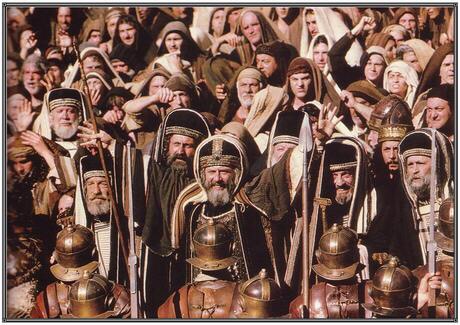

Lest they should be defiled 

John 18:28-29 “Then led they Jesus from Caiaphas unto the hall of judgment: and it was early; and they themselves went not into the judgment hall, lest they should be defiled; but that they might eat the passover. [29] Pilate then went out unto them, and said, What accusation bring ye against this man?”
Is it just me, or is there some major hypocrisy here? We see men who would stay up all night (really had been for days), planning how they could by subtilty and deceit catch and harm an innocent man. The night before they had gone with Gentile guards and soldiers into the garden to illegally arrest and “try” Jesus. And yet, they refused to go into the judgment hall because they didn’t want to be “defiled.” And worse, I wonder what Pilate thought when they stood without and made him come out to them once Jesus had been sent in With the soldiers. Then further, they couldn’t even answer what it was they accused Him of. Oh my. What a double standard. What a bad testimony from people who were supposed to have the oracles and testimony of God committed to them. 

I’m reminded in reading this record, of the importance of keeping a soft heart, and keeping hypocrisy out of my life. We see in Scripture that when we allow these to creep in, it’s a downhill road from there. Not only are we blind to the wrong in our own lives, but we strain at a gnat in others’, and can become a bad testimony to the world. Might we examine our hearts and lives, that we might see clearly, judge righteously, and practice grave and truth as our Lord did and does. 

Not be offended (stumble). 

John 16:1,12-13 These things have I spoken unto you, that ye should not be offended. [12] I have yet many things to say unto you, but ye cannot bear them now. [13] Howbeit when he, the Spirit of truth, is come, he will guide you into all truth: for he shall not speak of himself; but whatsoever he shall hear, that shall he speak: and he will shew you things to come. [33] These things I have spoken unto you, that in me ye might have peace. In the world ye shall have tribulation: but be of good cheer; I have overcome the world.
I appreciate Jesus’ upfrontness and honesty with His men. His desire was that, when He was gone, they would continue to stand, and not stumble when things go wrong. And therefore, He told them of hard things to come. Things wouldn’t always be rosy and happy. Tribulation would come. Persecution would come. Heartache would come.  And when it did, He wanted them to remember that He had told them it would. He’s also wise in this regard, in that there were some things He didn’t think they were ready for, and held them back from telling them. But at the end of it, He says, “These things I have spoken unto you, that in me ye might have peace. In the world ye shall have tribulation: but be of good cheer; I have overcome the world.” He said “through it all, realize that I have overcome the world, and because you are in me, you can have peace, and be an overcomer as well.” 

This is great learning both as we work with people – to apply these principles of teaching that Christ did as we disciple, and also for us, as we go through this life, to remember what He said. Thank the Lord that we serve a God Who has and will overcome, and through Whom, no matter what Happens today, we’ll be more than conquerors. 

Abide in me

Large bunches of ripe black grapes on vineJohn 15:4-5 Abide in me, and I in you. As the branch cannot bear fruit of itself, except it abide in the vine; no more can ye, except ye abide in me. I am the vine, ye are the branches: He that abideth in me, and I in him, the same bringeth forth much fruit: for without me ye can do nothing.

This morning’s reading reminds me of the necessity of full dependence on Christ. As a branch can do nothing of value apart from the vine, so we can do nothing of eternal value apart from being connected to Christ. The word abide has to do with residence. It’s not a one time, check in by 2:00 and out by 12:00 kind of thing. It’s a constant, continual living and communing and residing with Christ, and vice versa. For, when we do, two great things happen: We’ll bear much fruit, and the Father will be glorified (our good and God’s glory!).

Of course, “abiding in Christ” and “abide in my love” are not just feel good phrases. There are three principles He gives that must go along abiding in Christ. First, is that His words must abide in us. We must get into the word. But further, we must allow His Word to get into our hearts and souls. But we can’t stop there. We must then “keep His commandments”. We must follow what the Word says. Head knowledge isn’t enough – it’s a heart knowledge that leads to actions that He is looking for in us. And then, once we have this, we’ll realize that the commandments – His words – push us to “continue in love”. If we follow the true spirit of His commands, and practice abiding in Him, it must be in accord with His spirit of love for the Father and love for others. These three things will help us to abide in Christ, and in turn, to have Him to abide in us.

Let not your heart be troubled.

403fe044e72715f228b2dd3c3b91adc3John 14:1 Let not your heart be troubled: ye believe in God, believe also in me. In my father’s house are many mansions… I go to prepare a place for you.

John 14:27 Peace I leave with you, my peace I give unto you: not as the world giveth, give I unto you. Let not your heart be troubled, neither let it be afraid… I go away, and come again unto you.

Our world may fall apart, and persecution may come. Heartache and heart break will, no doubt, arise during our tenure on this earth. But I’m thankful that in the midst of it all, with Christ, we have an advocate and Comforter. He says “let not your heart be troubled” twice in this chapter. He further shows His desire for us to have inner peace in the face of it all. But here’s the unique thing He says about the peace we ought to have – it’s “not as the world giveth” peace. It’s a peace the world cannot have, and for the following reason:

If you look at the context of both of these verses, our peace in found in the realization that one day, despite what’s going on down here, and despite our losses and heartaches, ONE DAY – yes, one glorious day, He’s coming back to get us. One day, we’ll see mansions that He’s prepared for us. One day, it’ll all be over. One day, we’ll be whole, and perfect, and forever more with Him. One day, the tears will be gone. One day, our “toil here below” will end in eternal rest and rejoicing. One day, we’ll see loved ones gone before. One day, the devil will be bound and cast away, never more to torment and accuse and discourage and cast down. And when I realize that that day is very real and very imminent, I can have a peace that the world will never know.

Might we find our peace this morning in the fact that He’s preparing a place for us now. Let us live today with “that day” in mind. For when we do, we can follow His exhortation to “let not your heart be troubled.”

Worthy sacrifice 

John 12:3-5 Then took Mary a pound of ointment of spikenard, very costly, and anointed the feet of Jesus, and wiped his feet with her hair: and the house was filled with the odour of the ointment.
John 12:24-25,27-28 Verily, verily, I say unto you, Except a corn of wheat fall into the ground and die, it abideth alone: but if it die, it bringeth forth much fruit.

Today’s reading is about self-sacrifice. Two passages stick out. First, is where Mary pours very expensive ointment on Christ, and wipes His feet with her hair. She is criticized and misunderstood for this sacrifice. Yet, after all Christ had done for her – raising her brother, befriending their family, comforting them in sorrow, saving them, and more, how could she not? And as I think of all that the Lord has done for me, no sacrifice is too great.
Secondly, I see Christ’s illustration of a grain of wheat. For a corn of wheat to grow, and yield fruit, it must die, and even rot, and come to nought, before it brings forth fruit. It isn’t desirable business. Even Christ had thoughts of letting the hour “pass from Him”. But the sacrifice is worth it to bear much fruit for Christ.
Sacrifice – After all He’s done for me, how could I do less than give Him my best?

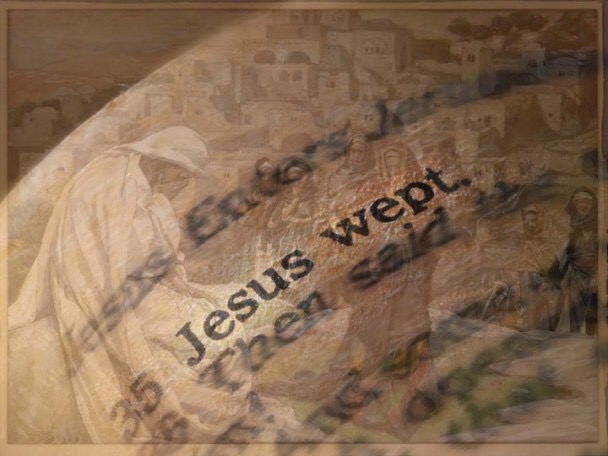
Jesus Wept 

John 11:35 “Jesus wept.”  

This is the smallest verse in Scrupture, and yet it is a powerful one. Thoughts and meditation on this verse can go so many directions. Two initial thoughts come to mind. The first is the obvious and primary application. This is that Jesus can be touched with our infirmities, and is willing to bear our grief. He loves and is compassionate. Thank God for this in our times of sorrow. 

The second thought is that, though Jesus was a man’s man – as a carpenter, as a man with a self-made scourge to drive out men from the temple, as a man who was willing to live ruggedly with no pillow, as a man who called the rich and influential adulterers and full of junk, and much more – He was also a man who wept. When He came to Jerusalem and saw how hard their heart was and of the coming destruction of e city, He wept. In the Garden, He wept. At Lazarus’s Grave, He wept. Many times Scripture records Jesus’ weeping. This reminds me of the song, “Lord, let us weep again.” I’ve found that it’s when my heart gets a little calloused that I have a hard time weeping. But when it’s in tune with the Lord’s, we can weep over “our city”, or people that are hurting, over sin, or the lost, or over things that break our or God’s heart. Maybe a heart check is in order to ask, when was the last time I wept over one of these things? After all, the greatest Man did oft times. 

John said…

John 10:40-42 “And went away again beyond Jordan into the place where John at first baptized; and there he abode. [41] And many resorted unto him, and said, John did no miracle: but all things that John spake of this man were true. [42] And many believed on him there.”

If this chapter doesn’t testify of the deity of Christ, I don’t know what does. From knowing the Good Shepherd’s voice, and being known of Him, to entering into the fold through Him alone, to His testimony of coming from the Father,  and being equal with God, this chapter is packed with doctrinally rich stuff. It is the last two verses, however, that I want to write on this morning.

Jesus had been kicked (really, He escaped) out of the temple for claiming to be God’s Son. And so He went out to a remote desert area where John used to preach and baptize. And many people heard of it, and began to resort to Him. There is a phrase that made an impression as I read this this morning.

When the people came to Jesus, they said, “all things that John spake of this man were true. And many believed on him there.”  By this time, John had already “decreased”. He was not in the picture. He didn’t have an audience. He no longer had a “voice” in the wilderness. But we see that his impact lasted beyond his time. And when people remembered what he said about Jesus, many believed.

Why did John continue to have this impact long after he was gone? I believe there are two reasons. First, he pointed people to Christ. His primary reason for living was to point people’s hearts toward the Lord. And secondly, he was consumed with the Lord’s will. When his disciples followed Christ, he was fine with it. When he had to decrease, he was fine with it. And because of these two things, when he was gone, people were still going forward in Christ’s cause.

As I think of my father, and many Christians of the faith, whose lives made an impact after their voice had faded, I think of these two reasons. Might we follow this example. Might we point people to Christ. And might we live with His vision and His heart and His purpose as our life’s passion, and spread these things to all we can.

The works of God should be manifest in him.

John 9:3 Jesus answered, Neither hath this man sinned, nor his parents: but that the works of God should be made manifest in him.

Again, there is much on which to write from this chapter alone. However, we’ll choose just one simple thought from the story of this blind man, who was made whole. We see here that there are times that the Lord allows trials and hardships and even infirmities so that He can get glory through the Son’s working in our lives. This is not unfair. This is not wrong. For His pleasure we are and were created. It’s not always a fun process, but the results are sure worth it. And through it all, let us remember that all things work together for good, to them that love God, and are the called according to His purpose.

a-woman-caught-in-adulteryJohn 8:7-10 So when they continued asking him, he lifted up himself, and said unto them, He that is without sin among you, let him first cast a stone at her. And again he stooped down, and wrote on the ground. And they which heard it, being convicted by their own conscience, went out one by one, beginning at the eldest, even unto the last: and Jesus was left alone, and the woman standing in the midst. When Jesus had lifted up himself, and saw none but the woman, he said unto her, Woman, where are those thine accusers? hath no man condemned thee?  She said, No man, Lord. And Jesus said unto her, Neither do I condemn thee: go, and sin no more. 

Jesus knew the perfect resolution to this scenario. And, as a searcher of the hearts, He knew what the results would be. “Let you that is without sin…” Jesus knew that the singular way to change the spirit of condemnation among these men was to get them to look inwardly, at their own hearts and lives first. And when they did, they realized that there were some glaring “beams” in their eyes. Jesus first addressed the law of casting a stone, as the witness, first. It was he who witnessed this act that should step forward before the others. But there was a problem for him, for if he identified himself, he would no doubt have to identify the man who committed adultery. Oh, but this leads to another problem. The men excused themselves much in this day and age, which leads us to the next point. This was an adulterous generation.  Romans 2 shows us this. Jesus identified them as such in the Gospels. And He knew the adultery that went on in their ranks. It may have been physical adultery, and it may have been emotional or mental adultery. But nonetheless, Jesus got to the heart of the matter – “He that is without sin”cast the stone first. In this context, “he who doesn’t have this type of sin in his life is free to come forward and cast a stone.” It was after these two points that these men, convicted in their OWN conscience, began to walk away, no longer with the spirit of condemnation with which they came.

I am reminded one sure way to keep the spirit of condemnation out of me is to take an honest assessment of my own heart and my own life. And when I realize and remember who I am, and the grace that sustains me each day, that spirit must begin to lose its grip in mine. That is not to say that we don’t deal with sin. Jesus said “go, and sin no more.” Sin cannot be allowed to spread. But my spirit will be more like Christ’s when I realize who I am, cast the beam out, and then am able to act as He’d want me to.